Quaternion Visualizer
I was reading about quaternions, so I decided to make a simple Quaternion library and visualizer in C++ to better understand them.
If you know what a complex number is, a quaternion is fairly similar. It is essentially a complex number with 3 imaginary components instead of one. I wanted to plot quaternions on a 2D graph to make visualizing quaternion equations easier to understand. Quaternions are often used to model 3D rotations. I first heard about them a few years ago when I was volunteering in a biophysics lab. One of the “killer features” is that they prevent gimbal lock, a major problem with modelling 3D rotations.
Using Complex Numbers for 2D Rotation
If you don’t know how complex numbers can be used to model 2D rotations, here is a quick recap. Consider the number . The argument is . If you square it, , which has .
In summary:
Similarly, dividing will rotate clockwise, instead of anticlockwise.
Multiplying or dividing any complex number by a number , will rotate by the argument of .
Using Quaternions for 3D Rotation
Quaternions work similarly for 3D rotations as complex numbers do for 2D rotations. Multiplying a quaternion will rotate an object, and dividing will rotate it back to the initial position.
Visualizations
In this project, I plot a vector of quaternions on a two dimensional grid. The X axis reperesents the element in the quaternion vector. The Y axis represents the versor value of the real component of each quaternion. For the red, green, and blue values of each pixel, I used the values of the imaginary components of the versors. for instance, the unit quaternion would be gray ( for each imaginary component). Negative values go to 0, positive values go to 255.
Adding complex components
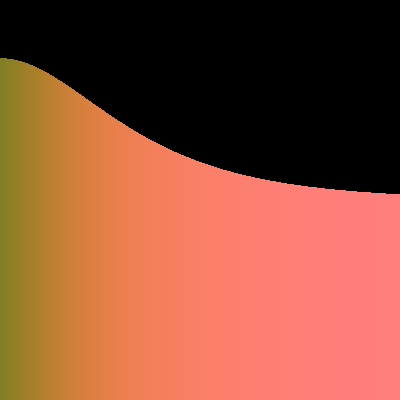
In the picture below, I started with the quaternion , and added for every element in the size 400 quaternion vector.
Rotating numbers via multiplying by a constant
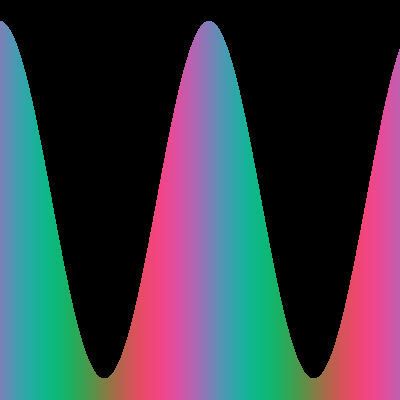
This one is more interesting - I am rotating the quaternion by the quaternion. Notice that the rotation quaternion is a versor (it has a norm of 1). Since it’s nearly entirely a real versor, it rotates slowly around both the real and complex components, which is why the below image is sinusoidal in the Y axis and in color space (it rotates through colours) !